I’m not going to lie here – I have a bit of a thing for Exmoor Blueface. It could be because I love Exmoor – it’s one of the most starkly beautiful places in the world. Or maybe it’s the name – it conjurs up delightful images of cartoony sheep with sky blue faces, prancing around and grinning, well, sheepishly.
It could be both of those things, but it ain’t. It’s because the wool is blimmin’ gorgeous.
It’s hard to write about this – society doesn’t really want to hear the tale of one woman’s love for her wool. But you will, my fellow felters (and if you’re not yet felters, be not put off by this review, for one day you will find a fibre that is your love – your woolmate.) And Exmoor Blueface is the wool that got me hooked on felting, the wool that sends me into a panic if my stocks run low.
It’s good wool, is what I’m saying.
So where better than to start the Wool Review with this, my first favourite fibre.
About the wool
The Exmoor Blueface sheep is a cross between the Exmoor Horn and Leicester Blueface. In my research so far I haven’t found many suppliers of this wool or breeders of this sheep.
Purchased from John Arbon – £3.75 per 100g + p&p
Exmoor Blueface can also sometimes be purchased from Sara’s Texture Crafts
Available Colours – Natural White
All images, unless otherwise specified, shows wool purchased from John Arbon.
First Impressions
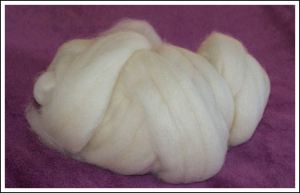
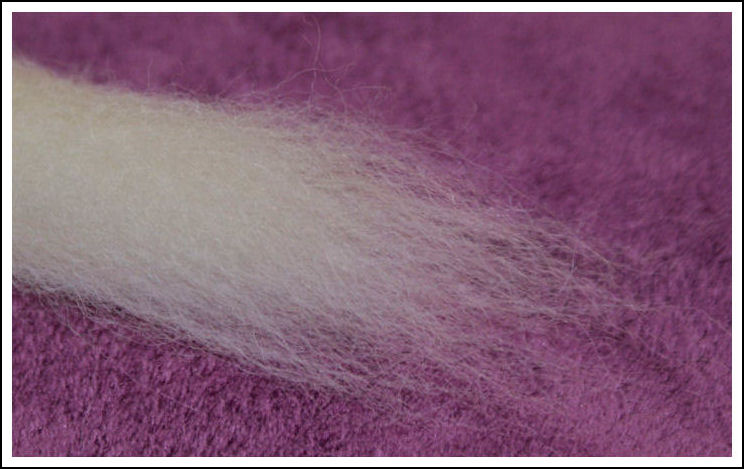
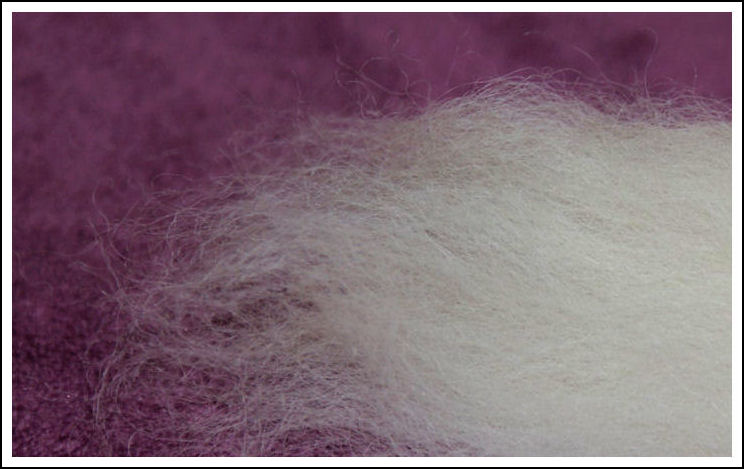
The Exmoor Blueface has a pleasant sheepy smell – I could sniff it for hours! The colour is a pale creamy white and the fibres have a nice crinkly texture to them, feeling strong yet easy to pull apart. There is no vegetable matter and the fibres are even and mid-length, with very few (if any) coarser guard hairs.

Looking closely at the fibres reveals a nice crinkly effect that helps the wool felt easily to itself or other wools.
The Ball Test
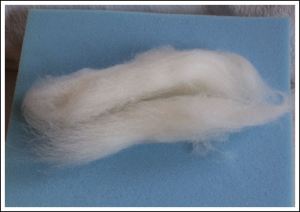
0-3 minutes, using a 36 triangle needle
The ball is relatively easy to form by rolling the length of the fibres and tucking in the ends as I turn it. It does slip at times, but is easy to keep in place. It’s holding the shape together, but very loosely – at this stage I feel parts could still unravel.
The ball at this stage is not very round and is still quite squidgy.
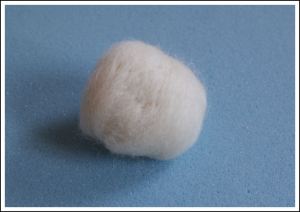
3-5 minutes mark, using a 36 triangle needle
After felting for two more minutes the ball is now rounder and feels more secure. It’s still fuzzy in places but is beginning to get quite neat. Likewise it has become more compact but is still squidgy in places – I feel that it could be considered complete at this point (and may be a good point to consider adding eyes etc if you need to sew them in) but it is probably still too hairy and squashy for most people.
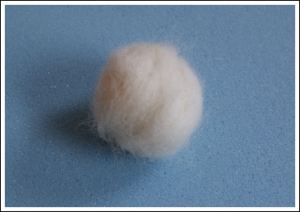
5-10 minutes mark, using a 38 triangle needle
By this point, having switched to a 38 triangle needle, the ball starts to take a much rounder shape, and by the 10-minute mark it is very round, albeit not perfect. It is a little bumpy in places, and still a little squashy and hairy, but not enough to put me off – at this point I would be happy to consider it finished and use it.
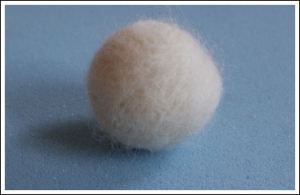
Finishing the ball (10+ minutes – ball finished at 15 minutes)
After another 5 minutes with the 38 triangle I would consider this perfectly finished. The ball is smooth and round and feels tight to touch. At this point it may be too tight for adding eyes if you haven’t already made sockets in position.

In Summary
Would you create a whole model in this wool?
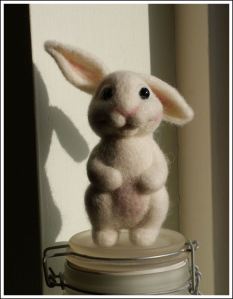
Whilst the eagle-eyed among you will notice Mr Bunny here has a pink nose, belly and ears, the rest of it is made solely from Exmoor Blueface. It did require a bit of patience and a 40 triangle needle to seperate some of the closer fibres, but the end result is lovely.
Similar to Exmoor Blueface…
Please note that different clips may produce wool that differs from the description given above. All wool reviews are based on the quality of the clip I am using at the time of review.
Some photographs have been edited to ensure images represent the wool as true-to-life as possible, as apparently the ability to take accurate pictures of wool is not one of my strengths!
 flippity felts